|
LEVELS
Grades 1-8
SUBJECTS
Computer Science, Geography, Language Arts, Science, Social Studies, Visual
Arts
SKILLS
Comparing and Contrasting, Formulating Questions, Observing, Representation,
Research
OBJECTIVES
Students will 1) discover some of the resources, products and characteristics
of their region and 2) describe similarities and differences between their
region and another region with respect to these characteristics and
3) identity and evaluate the strengths and weaknesses of information gathering
via the Internet.
MATERIAL
A computer with Internet access; books about the natural history of your
region; markers, crayons, drawing paper and other art supplies.
TIME CONSIDERATIONS
Preparation: 30 Minutes
Activity: Three 50-minute periods |
|
|
|
Project Learning Tree (PLT) is a program of
the American Forest Foundation (a nonprofit education and conservation organization).
PLT's mission is to increase students' understanding of our environment,
to stimulate critical and creative thinking, to develop students' ability
to make informed decisions on environmental issues, and to instill in students
the confidence and commitment to
take responsible action on behalf of the environment. For more information
on PLT's educational materials and teacher workshops, call 202/463-2462
or
visit the PLT Web site at: www.plt.org.
 |
|
|
|
Pre or Post Activity
Before or after your class participates in the Environmental Exchange Box,
have them participate in the Earth Day Groceries Project, a cost-free, easy-to-implement
environmental awareness project that teams up students, teachers and grocers
on behalf of our environment. To participate in the Earth Day Groceries
Project, teachers simply borrow a supply of paper grocery bags from a local
grocery store. Then, students decorate the bags with friendly environmental
messages and return the bags to the grocer. On Earth Day, April 22, shoppers
receive their groceries in the decorated bags. Teachers are encouraged to
E-mail a short report detailing their class or school's participation to
the project's user-friendly, interactive Web site: www.earthdaybags.org.
Use the map on the home page of the Earth Day Groceries Project Web site
to locate a class with which you can participate in the Environmental Exchange
Box activity.
Getting Ready
Select a state and classroom to work with by clicking on the map on the
home page of the Earth Day Groceries Project Web site (see Pre or Post Activity
section above). Review the teacher reports for that state and send an E-mail
to the teacher explaining that you'd like to participate in an environmental
exchange. (Note: You may want to contact more than one teacher with your
request to ensure you receive a response). Exchange contact information
and provide the other teacher with a copy of these directions, available
at: www.earthdaybags.org. Agree
on a date to begin and complete your environmental exchange.
Doing the Activity
1. Once you get the name and address of your "exchange
partner," tell the students that they are going to exchange "environments"
with students in another region. Explain that the students you're exchanging
with will not know much about your local environment. It's the responsibility
of your group to prepare items for the box that will teach your exchange
partners about your region.
2. Brainstorm
with the students a list of items to include in the box. Then have the students
divide up the responsibilities of researching, collecting and preparing
materials for the box. Items to choose from:
- brief descriptions of your region written by the
students
- a collage of pictures of local ecosystem types (beaches,
marshes, deserts, urban environment)
- a book with drawings of some interesting local plants
and animals
- photographs of your class and school/classroom
- photographs of your students' bag artwork for the
Earth Day Groceries Project, along with a sample decorated bag
- a video or recording of local ecosystems (including
the sounds of your area, animals, and so forth)
|
- stories written by the students about their favorite
things to do or favorite outdoor places to go
- samples of special regional foods such as maple
syrup from Vermont or prickly pear jelly from Arizona
- a few representative natural objects from your area
such as pressed flowers or leaves; rocks; shells (see safety notice below)
- news clippings about local environmental concerns
and solutions, such as recycling programs.
|
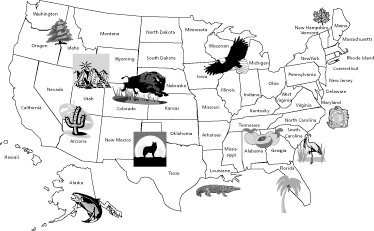
3. While
you're waiting for the box from the other group to arrive, ask the students
what they know or have heard about the region they're exchanging with. Can
they name major cities, geographical landmarks or other features of the
region? What is the climate like there? What types of trees grow there?
Record the students' ideas and preconceptions on a chalkboard.
4. When the
box arrives from your exchange group, open it with the students and examine
its contents. Then have the students compare and contrast that region to
their own. How do the climates compare? What kinds of plants and animals
live in both places?
5. Have students
use the Internet to get further information or clarity on particular points
of interest, such as climate, terrain, wildlife, geography and culture.
Have younger students use the exchange box to create
a representation (story or picture) of what they liked most about the other
areas or what they imagine it would be like to live there.
6. As a wrap
up, have students E-mail a thank-you note to the exchange class. Have students
formulate a list of their impressions of the box, including what they liked
best, along with any questions about the items that were included. Each
student may also hand write a thank-you note.
Safety notice: On occasion, specific plants
and soils are placed under quarantine by state or federal authorities, and
should not be removed from their state of origin. Please check with your
State Department of Agriculture to ensure all items in your Exchange Box
are safe and legal to mail.
|
Assessment Opportunities
1. Discuss the concept of conservation using
the exchange box your class made. What actions could be taken to conserve
the resources used to make the products that are in your exchange box. Also,
if your class has participated in the Earth Day Groceries Project, discuss
the importance of reusing and recycling paper products such as paper grocery
bags, boxes, notebook paper and newspaper.
2. Discuss
the similarities and differences, and the value of, the information the
students received about their exchange region via the Internet (immediate
access; written descriptions, photographs) versus from the box they received
by mail (slower access; tangible items the students can touch, taste, smell
and see). Have students compare their preconceptions of their exchange area
(step #3) with what they learned from the items in their box and their Internet
research. |
|